Cincinnati Public Stairs Explorer
Links
Tech Stack





The City of Seven Hills
In June 1853, a writer for the West American Review named Cincinnati's defining feature: the seven hills that arc above the Ohio River. The comparison to ancient Rome was explicit: both cities rose from river valleys on seven hills, their streets forced to negotiate terrain that no grid could tame.[1] The name stuck. Cincinnati's seven hills (Mount Adams, Walnut Hills, Mount Auburn, Vine Street Hill, College Hill, Fairmount, and Price Hill) form a crescent above the Ohio basin, each neighborhood perched fifty to a hundred feet above the valley floor.
Where there's hills, there's stairs.
Life on the Hills
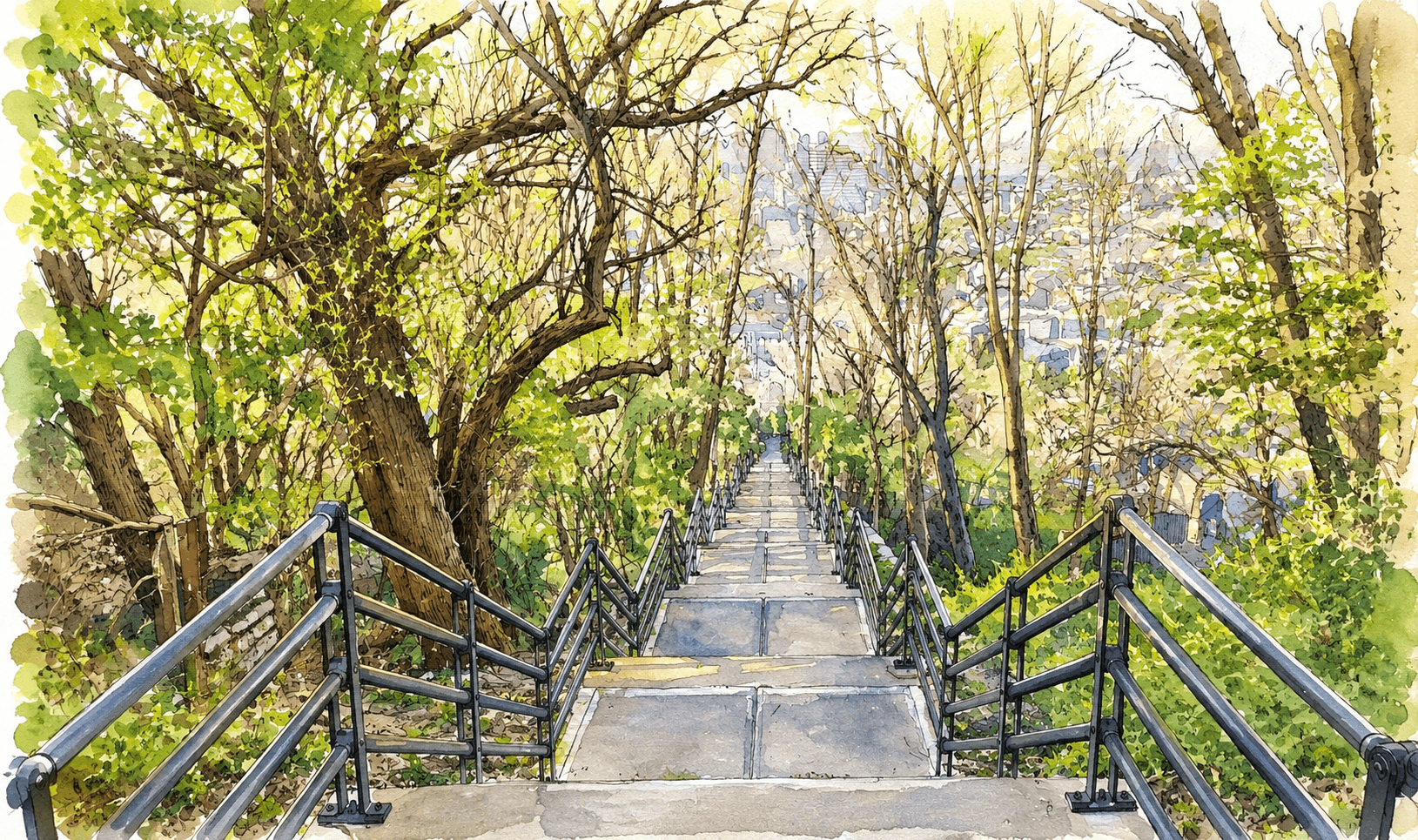
Cincinnati's a city built on hills, literally. Unlike most flat Midwestern cities, its neighborhoods climb steep valley walls carved by the Ohio River and its tributaries. For over a century, the city maintained a network of public stairways to help residents navigate those hills on foot: concrete and stone steps tucked between houses, cutting through green hillsides, and dropping down bluffs from neighborhoods like Price Hill, Mount Adams, and Fairmount.
At their peak, Cincinnati had more than 400 of these public rights-of-way.[2] They were how people got to streetcar stops, to work, to school.
Most Cincinnatians outside the hillside neighborhoods don't know they exist, and those who use them daily mostly take them for granted. They're just the way you get down the hill. Some are pristine. Some are buried in bramble. Most are somewhere in between.
Spring in our Steps
Spring in our Steps is a Cincinnati-based advocacy organization dedicated to the preservation, repair, and celebration of these public stairways.[3] They've spent years surveying every public staircase in the city, cataloging each one's location, step count, condition, and neighborhood, and compiled it all into a publicly available dataset: a comprehensive record of Cincinnati's stair network.
Spring in our Steps organizes walks, advocates for repairs with the city, and publishes their data openly so others can build on it. Their work is the foundation this project is built on.
The Spring in our Steps dataset is free and publicly available. This project is one example of what becomes possible when civic organizations treat their survey data as a public good rather than an internal spreadsheet.